Interview on Digital Biobank Applications: “We are aiming for a partial release in early 2026”
To simplify the process of applying for biobank samples while reducing the number of forms and documents, Biobank Sweden is looking to digitalize the entire application process. We have met with Hanna Fransson, Product Owner of SBR (the Swedish Biobank Registry), who is leading the work of digitalizing the biobank applications.
Hello Hanna!
How is it going with the digitalization process?
– It’s going well, but there is still some investigative work to be done. A lot has to do with finding a national perspective regarding the entire application process and to understand exactly what information the Swedish Biobank Act requires. What information is needed according to the Biobank Act? Exactly what information do we have to review? These are the types of questions that we are currently looking at.
Are you looking to digitalize all types of biobank applications or just some of them?
– The Steering Group of SBR prioritizes the regulative aspects of the application process. At the same time, we need to consider additional parts of the application process which might affect the operational work later. All in all, the digital process includes all of Biobank Sweden’s T-documents, L-documents and MTAs (Material Transfer Agreement).
Does this include both clinical trials and academic research?
– Yes.
Practically speaking, how do I apply for biobank samples once the digital solution is in place?
– Once we have launched the digital application process, users can log into our “Research Portal” which will be part of the SBR. When logged in, you can submit your biobank application and then sign it digitally as well. A Swedish personal identity number is needed to sign applications but there are no such requirements to use the portal and fill in information about the study.
Besides being able to apply for samples digitally, are there other additional functions available?
– All users will be able to track their ongoing studies. It will also be easier to make adjustments or submit requests of amendment for ongoing or completed applications. Additionally, it will be possible to get reminders and instructions if an agreement is expiring.
– We also have a function called ”Sök prov” (Swedish for “Search Samples”) which is sort of a feasibility service based on data from the regional biobanks’ systems for medical samples. This function enables researchers to get an indication of the number of samples available with certain characteristics, which could then potentially be used for research. This way, researchers could avoid collecting unnecessary new samples for their studies.
When do you think researchers and clinical investigators can apply for samples digitally?
– The full application process will probably not be available for another couple of years. We are aiming for a partial release in early 2026 which focuses on the ethical framework which specifies what the study is allowed to do. The first launch will include the L-documents and focus on studies that are not clinical trials.
– Our plan is then to gradually develop the application system step by step, by starting with one application template and then continuing to work through the various forms until the entire process is in place. This will allow us to provide additional support to users with each new update we release, while also gaining valuable insights to ensure we’re on the right track.
Lastly, what benefits do you see for biobank personnel working with digital applications?
– A lot of the improvements are about having a better support system for the entire application process, especially in terms of the traceability and general overview. Personnel working with applications will be able to take over ongoing applications from colleagues knowing exactly where to begin and what to do with the application. It will also be possible to have digital checklists as a technical aid to review incoming applications.
– When the entire process for digital applications is in place and agreements have been signed, a study is created in SBR along with sample collections and all agreements. This will enable personnel to see which studies are ongoing nationally and in what regions. The aim is that SBR should be the only tool needed to have full control. There should not be a need to manage applications in Excel documents or binders.
Latest update: 2025-11-10
New guide regarding sample handling in national studies
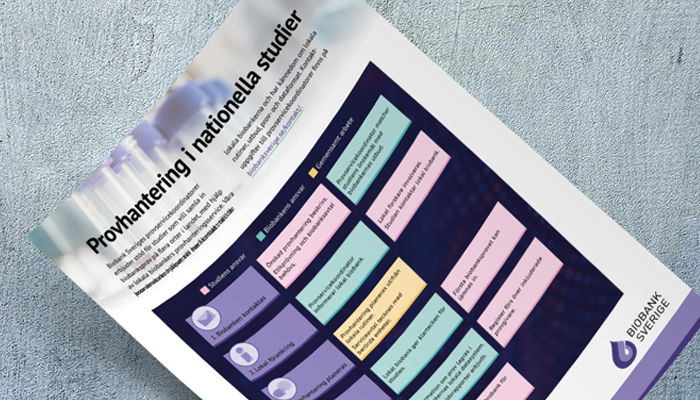
The guide “Sample handling in national studies” is now available for download. The guide contains a schematic overview of important steps for studies wishing to collect biobank samples from multiple…
After careful considerations, Biobank Sweden’s steering group has decided to remove the form N3. The document has previously been used to report on completed sampling in multi centre studies. It…
New project to improve efficiency of healthcare integrated biobanking and strengthen Swedish research
Biobank Sweden has secured project funding through Swelife to ensure a continued development of the successful model ‘healthcare integrated biobanking’. The project which will go on until 2026, aims to…



 Read more